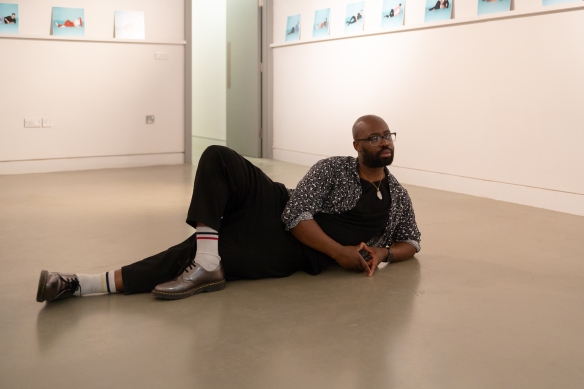
Paricia L Boyd presented her past 3 years of artwork, produced whilst living in San Fransisco.
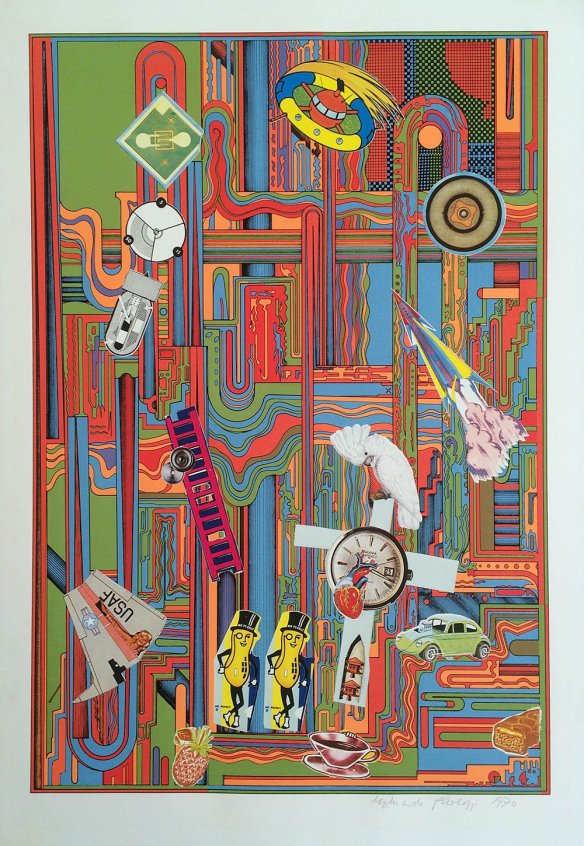
She explained her interest in Liquidation auction catalogues, and her investigation into ‘post intelligence’, which were an AI company. She went on to show the images that interested her from this catalogue containing the miscellaneous objects this company aimed to sell.
She also introduced her other interest in ‘Grease cycle’, which was a local authority scheme to recycle the grease found in restaurants to be used as biofuel in cars.
At first, she explained, that she didn’t see a connection between these two interested, however, it developed after her exploration of the sewage works, photographing the vats containing sewage and grease.

‘Formation’

‘Formation’
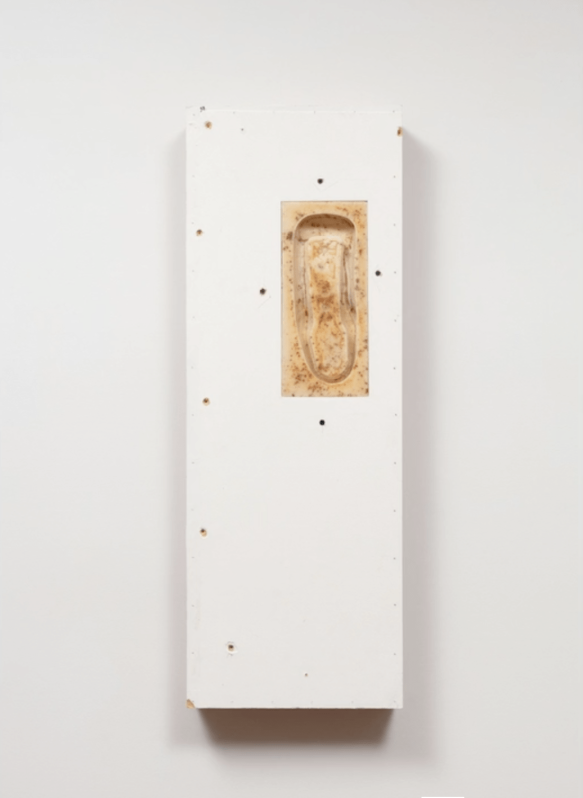
She talked about her group show at the CCA What is institute. This project began when she bought two items from the liquidation auction: an office chair and a turntable. She went on to explain how she took these objects apart, deconstructing them to inspect their individual parts. After this she took moulds of these parts, using a mixture made from grease. She stated that she enjoyed how this disgusting mould, made of sewage, glistened and became something almost beautiful when cast.
I found her relationship with the exhibition spaces and her work the most interesting aspect of her talk. Boyd embedded her moulds into the wall, presenting the negative of the chair or turntable part in the mould, whilst half of the mould was hidden inside the wall. This came from her interest in the negative space and forms of relief in the moulds. She also explained that there were captions connected to the works, to give the audience information on the mixture used to create the moulds and how the system regarding liquidation and grease cycle worked.
Boyd explained that her chosen parts, a turntables feet and the back of an office chair, had a linked purpose. She explained that she saw these parts as providing the user stability, where the turntable’s feet held itself in place and the back of the office chair supported the users back.
This group show travelled to Vienna. Here Boyd continued her work with moulds, this time exploring the variation in the material used to create the moulds through the replication of the same cast. She explained her interest in the relationship between the standardised mould and the unstable, disgusting material used to make it.
Boyd also presented some of her video work, created alongside Lucas Quigley. The video shown presented a camera slowly diving into a pipe of sewage at the top of a building, then once it had reached the bottom the camera was very quickly pulled back out. I found it interesting how Boyd had forced this video to be seen. They had interrupted a URL for a website, so that when clicked onto the audience had no choice to watch the video, as it stopped them seeing or accessing the website at all, with the video taking up the screen.
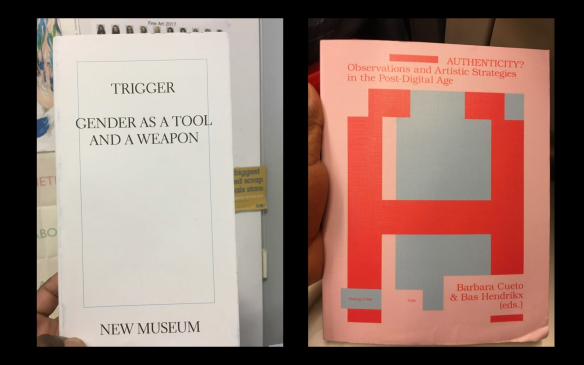
After this played she talked about her other show, ‘Good Grammar’. Here she explored her relationship between the exhibiting of her work and the work with herself. This came from the laborious nature of installing the work, and how to present the work she had to cut into a gallery’s walls. She felt that this represented how her artwork was expanding and escaping the limits of the gallery’s space. As well as her moulds, she presented two videos on TV Screens called, ‘This is a list of do’s and don’t’ and ‘dotting your I’s and crossing your T’s’. These videos were created in reaction to two gramma guide books, and how their supposedly ‘neutral’ sentences, used to demonstrate grammar, for her, demonstrated singular ideas on subjects such as gender, to be and how to work. She found it also acted as constructing a reality, without intending to.
Boyd showed another video, which she had been commissioned to make as an advert for the Superbowl. The 2013 advert was called ‘Men Ascending’, and consisted of a man assembling and disassembling a car. She then recorded this advert within the other adverts and shows, due to her interest in the relationship and sandwiching effect.
Boyd continued to show the development of her sculptures, and how she took the surrounding wall that her moulds had been installed into and then displayed the sculpture and its wall as a whole.
 After this, she presented another project called ‘Absorption and Elimination’, where she experiments with photo ground methods. She created large pieces created from shop windows with graffiti on them. She presented this in Melbourne, Australia in a trade union hall, due to its non-typical location as a place to exhibit artwork. She explained that she was looking at the idea of public and private and became interested in bus shelters, due to their public use, but private ownership and how they are both enclosed and open spaces. She created further pieces from the glass on the bus shelters.
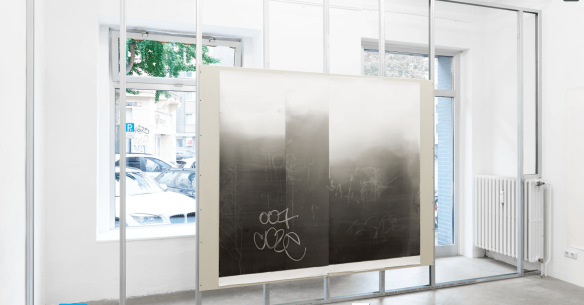
‘Absorption and Elimination’
Overall I found that Boyd’s exhibition methods were the most interesting aspect of her work, I especially enjoyed how she embedded her pieces into the wall and adjusted the space to accommodate her work and not the other way round. I would like to explore the limitations of exhibition space myself, through installing my own work.